Quick Summary: How Does the Ontario DriveTest Scoring System Work?
On Ontario G2 and G road tests, examiners score candidates using a standardized Ministry of Transportation (MTO) evaluation sheet. There are two ways to fail a road test:
- Automatic Failure (Instant Disqualification): Committing any single dangerous action (e.g., mounting a curb, examiner intervention, near-collision), violating traffic laws (running a red/stop sign, speeding), or arriving with an unsafe vehicle.
- Accumulated Point Deductions: Accumulating more than 30 minor error checkmarks across vehicle control, observation, lane positioning, or speed management.
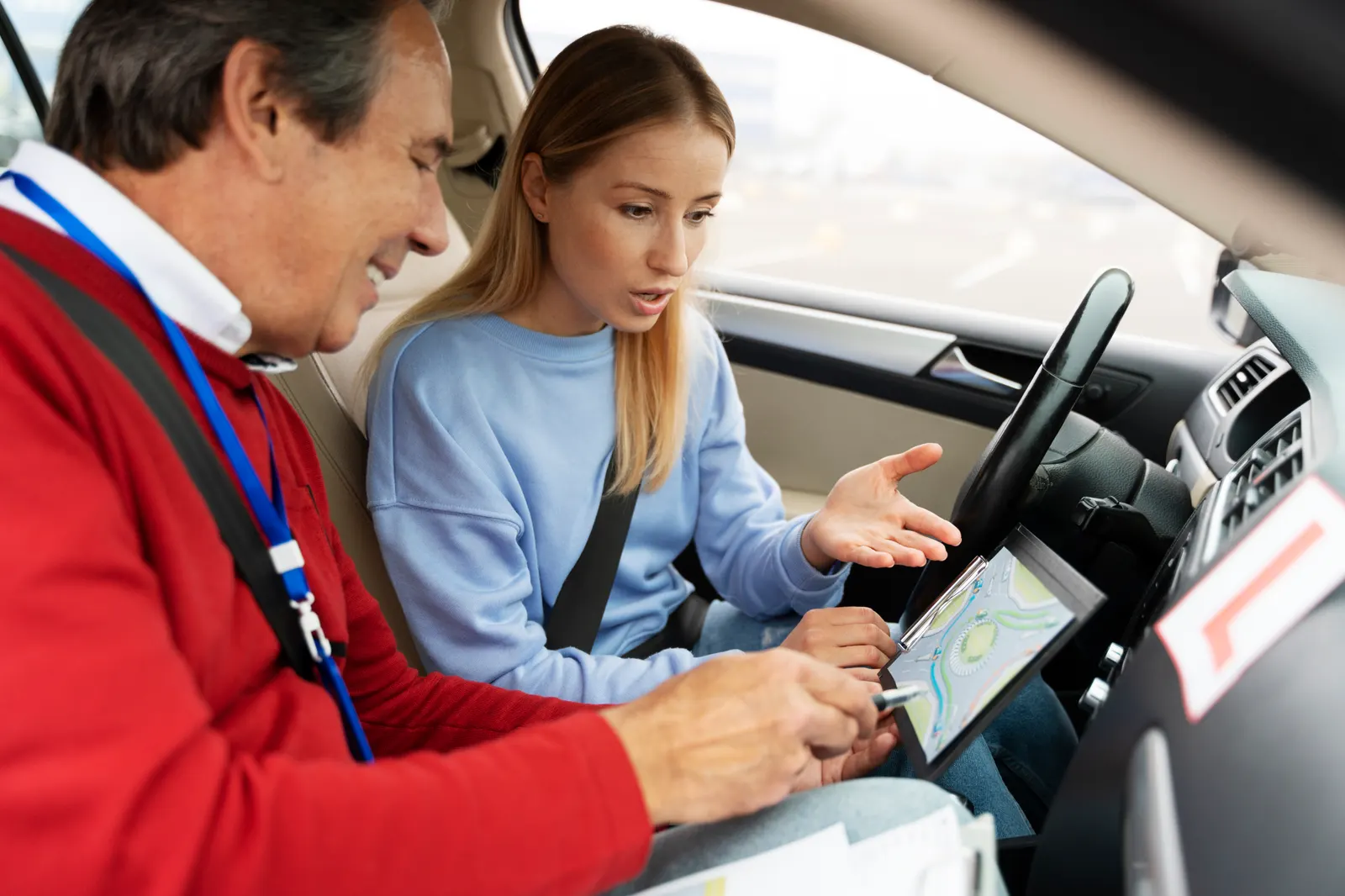
Sitting next to a DriveTest examiner holding an evaluation clipboard or tablet can be nerve-wracking. Every glance they make and every checkmark they record feels like high-stakes pressure.
The secret to walking into your road test with absolute confidence is understanding exactly what the examiner is looking for. The DriveTest evaluation isn't arbitrary or subjective—it follows strict Ontario Ministry of Transportation (MTO) performance guidelines.
Here is an in-depth breakdown of the official Ontario DriveTest scoring sheet, the 4 catastrophic automatic failure triggers, common minor point deductions, and how to pass on your first attempt.
The 4 Automatic Failures on Ontario Road Tests (Immediate Termination)
An automatic failure means the test is immediately terminated. Regardless of how well you performed on earlier maneuvers, committing any of the following four actions results in an immediate fail:
1. Dangerous Actions & Examiner Interventions
Any action that jeopardizes public safety or requires the examiner to physically or verbally intervene results in an immediate automatic fail. Examples include:
- Examiner Intervention: The examiner grabs the steering wheel, taps the emergency dual brake, or shouts a verbal instruction to stop an imminent collision.
- Climbing the Curb: Brushing the rubber of your tire lightly against a curb during parallel parking is typically scored as a minor error; however, jumping or mounting the curb with a tire climbing up onto the sidewalk is an automatic failure.
- Blocking an Active Intersection: Entering an intersection on a green light when traffic ahead is gridlocked, leaving your vehicle stranded in the cross-street path when the signal turns red.
- Unsafe Lane Changes: Changing lanes into an occupied lane without sufficient gap, forcing other vehicles to brake abruptly or swerve.
2. Highway Traffic Act (HTA) Violations
Because DriveTest examiners are licensed MTO evaluators, they cannot pass any candidate who directly breaks provincial traffic laws during their evaluation:
- Rolling Stops: Failing to bring the vehicle to a 100% complete, motionless stop behind the white stop line at a stop sign or red traffic light before turning right. "Rolling stops" (even at 2 km/h) are the single most common cause of instant failure in Ontario.
- Exceeding the Speed Limit: Driving faster than the posted speed limit (e.g., driving 55 km/h in a 40 km/h school zone or 115 km/h on Highway 401).
- Failing to Yield Right-of-Way: Proceeding ahead of pedestrians waiting at pedestrian crossovers or failing to yield to oncoming traffic during unprotected left turns.
- School Bus Violations: Failing to stop for a yellow or red flashing school bus with its stop arm extended.
3. Collision or Fixed Object Contact
Making physical contact with another motor vehicle, a pedestrian, a cyclist, a roadside barrier, a traffic sign, or a building results in an immediate test failure and report filing.
4. Vehicle Safety Inspection Failure (Disqualification Before Driving)
Many students don't realize that your test can be failed before your car ever leaves the DriveTest parking lot. The examiner conducts a mandatory pre-trip safety checklist. If any of the following fail, the test is cancelled immediately, and your booking fee may be forfeited:
- Brake lights (including the center high-mount third brake light) inoperative.
- Left or right turn signals not functioning front and rear.
- Working horn inoperative.
- Large windshield cracks directly obstructing the driver's field of vision or active wiper sweep.
- Driver or front passenger doors failing to open from both inside and outside.
- Driver or passenger seatbelts frayed or failing to latch properly.
- Valid licence plate sticker/registration and motor vehicle insurance slip missing.
Pro Tip: Need a Certified Test-Day Car? Don't risk having your test cancelled over a blown taillight bulb or dashboard warning. Through Drivisa test-day vehicle rental, you can rent a fully certified, dual-brake instructor vehicle that passes every MTO pre-trip inspection guaranteed.
How the Minor Point Deduction System Works
If you avoid automatic fails, your score is determined by the number of minor driving faults (checkmarks) recorded on your evaluation sheet. The sheet evaluates your driving across five foundational categories:
- Observation & Scanning: Checking mirrors every 5 to 8 seconds, executing pronounced head movements (not just eye glances), and performing shoulder blind-spot checks before every turn, lane change, or parking maneuver.
- Space Management & Positioning: Maintaining a safe 2 to 3-second following distance behind vehicles, staying centered in your lane, and leaving enough space at red lights to see the rear tires of the vehicle ahead meeting the asphalt.
- Speed Control: Maintaining consistent speeds appropriate for road and weather conditions, smoothly decelerating without abrupt braking, and matching highway flow during merge maneuvers.
- Signaling & Communication: Activating turn signals at least 30 meters (approximately 3 to 4 car lengths) before turning, lane changing, or pulling to the curb.
- Vehicle Handling: Smooth hand-over-hand steering, progressive braking, and complete control without jerking or stalling.
While an individual missed blind spot check or wide turn is recorded as a single minor tick, repetitive errors in the same category (such as missing blind spot checks 4 or 5 times) signal to the examiner a fundamental deficiency in basic safety habits, resulting in an accumulated point failure.
Critical Maneuvers Tested on G2 vs. G Road Tests
G2 Road Test Checklist (G1 Exit Exam)
The G2 test focuses on city, residential, and commercial driving skills (duration: 15–20 minutes):
- Three-Point Turn: Performed on a quiet residential street. Must signal before pulling to the right curb, signal left to begin the turn, check both directions 360 degrees, reverse smoothly, and drive forward in the new direction.
- Parallel Parking: Usually done behind a single vehicle or roadside obstacle. Examiners check proper reverse angle, continuous blind spot scanning, and stopping within 30 centimeters (1 foot) of the curb without hitting it.
- Roadside Emergency Stop: Pulling over to the curb safely, canceling your signal, activating 4-way hazard lights, and setting the emergency parking brake.
- Hill Parking:
- Uphill with a curb: Turn wheels sharply to the LEFT (away from curb).
- Uphill without a curb: Turn wheels sharply to the RIGHT (towards edge of road).
- Downhill with or without curb: Turn wheels sharply to the RIGHT.
- Always set your parking brake!
- Intersection Navigation: Left and right turns at controlled and uncontrolled intersections, scanning left-center-right before entering every green light intersection.
Full G Road Test Checklist (G2 Exit Exam)
The full G test includes all city maneuvers plus extensive high-speed 400-series highway driving (duration: 25–30 minutes):
- Highway On-Ramp Acceleration: You must accelerate aggressively up to the posted highway speed (100 km/h) on the on-ramp before merging into live highway traffic. Merging below highway speed is an immediate deduction or hazardous condition.
- Highway Lane Changes: Changing lanes smoothly to the left and back to the right at 100 km/h, requiring mirror checks, signal, shoulder blind-spot check, and gentle steering.
- Following Distance at Speed: Maintaining a minimum of 3 to 4 seconds gap between your car and the vehicle ahead at highway speeds.
- Highway Off-Ramp Deceleration: Do NOT slow down while still in the main highway travel lane. Signal, enter the deceleration ramp, and then brake smoothly to the posted advisory speed.
Top 5 Tips to Pass Your DriveTest Road Test on the First Try
- Exaggerate Your Head Movements: DriveTest examiners wear hats or sunglasses and look forward while writing. If you only move your eyes to check mirrors, the examiner may not notice. Move your entire head deliberately so your chin sweeps toward your side mirrors and rearview mirror.
- Practice on the Actual Test Routes: Every DriveTest centre has 2 to 3 standard routes for G2 and G evaluations. Booking practice sessions with local driving instructors on Drivisa who know your specific DriveTest centre (e.g. Mississauga, Downsview, Ottawa Walkley, Brampton) gives you a massive tactical advantage.
- Count "One-One-Thousand, Two-One-Thousand" at All Stop Signs: Come to a full cessation of vehicle motion behind the line. Feel the car settle back on its suspension before scanning left-center-right and proceeding.
- Keep Both Hands on the Wheel (9 and 3 or 10 and 2): Never drive one-handed or rest your arm on the window sill or center armrest during your exam.
- Complete an MTO-Approved BDE Course: Enrolling in an MTO-approved BDE course teaches you the exact defensive driving habits examiners score you on, saves you 4 months off your G1 wait time, and qualifies you for auto insurance discounts.
Frequently Asked Questions (FAQs)
1. How many points can you lose and still pass the G2 road test in Ontario?
While DriveTest does not publish an exact numerical threshold, candidates generally fail if they accumulate more than 25 to 30 minor infractions, or if they receive repetitive checkmarks for the same error (such as failing to check blind spots consistently). Any single automatic fail action results in an immediate failure regardless of total points.
2. Does touching the curb fail you on the G2 road test?
Lightly tapping or brushing the rubber of your tire against the curb during parallel parking is scored as a minor maneuver error, not an automatic fail. However, if your car climbs or mounts the curb (with the tire resting on the curb or sidewalk), it is classified as a hazardous action and results in an immediate fail.
3. Can I use a backup camera during my road test?
Yes, you may use a built-in factory backup camera as an additional reference tool. However, you cannot rely solely on the screen. The examiner expects you to physically turn your head and look over your right shoulder through the rear window while reversing.
4. If I fail my road test, how soon can I retake it?
Under Ontario MTO regulations, you must wait a mandatory minimum of 10 calendar days before you are eligible to retake a G2 or full G road test. You will need to pay the test rebooking fee ($53.75 for G2, $91.25 for full G).
5. Can I take my road test at any DriveTest centre in Ontario?
Yes. Ontario drivers are legally permitted to book their road test at any DriveTest location across Ontario, regardless of where they live. Many drivers choose locations with higher pass rates or shorter appointment wait times.
Ready to ace your Ontario road test? Book a mock road test with a certified Drivisa instructor or reserve a dual-brake vehicle for test day.