
Canadian winters can be scary for even the most experienced of drivers, with nearly 30% of accidents in Canada being related to winter weather conditions (Greg Monforton & Partners, 2025; Waterdown Collision, n.d.).
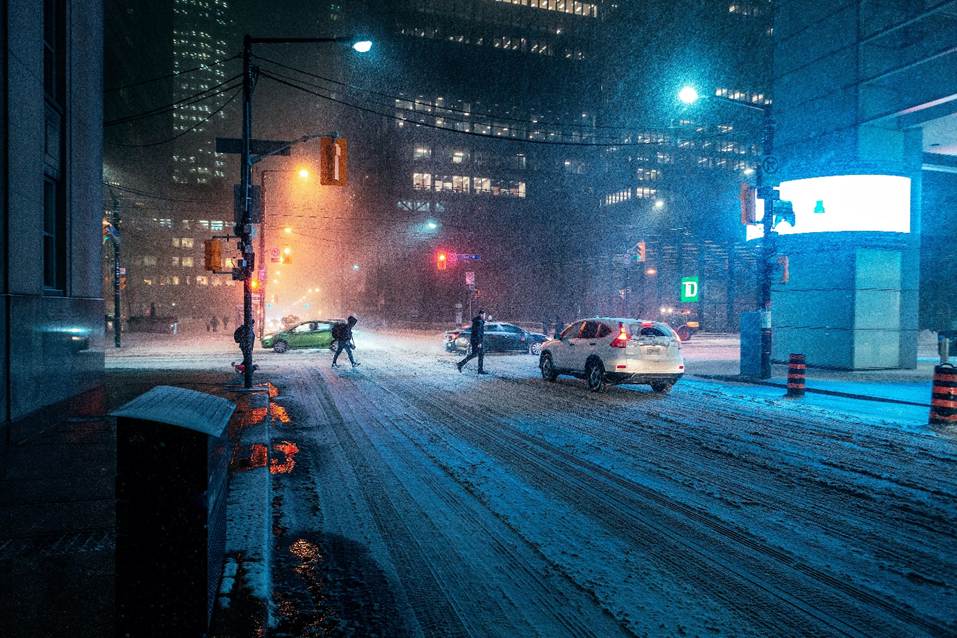
(Multiple cars driving on a snow-covered Toronto street during a winter snowstorm at night. Credit: Marcin Skalij, Toronto, Canada, 2023).
Already, 2026 has given all of us in Ontario a taste of arctic conditions several times this month. While all the snow days are more than welcomed by Ontario students, these conditions demonstrate the importance of learning winter driving techniques that help new and even experienced drivers stay safe.
To share some of these tips and tricks, we have asked some of our instructors to provide insight here and in future posts. This includes Drivisa’s Founder, Fares Bunnaih, who is still teaching students in-person after over 15 years in the industry!
The #1 Mistake that Puts New Winter Drivers at Risk
Following distance and stop time are terms and concepts discussed early in everyone’s driving journey. Most new drivers are familiar with the “one car length” rule for car distance when travelling. But, many have difficulty adapting these teachings to winter driving.
Drivisa’s founder, Fares, stresses that doubling these measurements for winter driving is essential. For example, Fares often uses the 2-second rule when judging stopping time during travel, since that is most people’s reaction time when driving. So, keeping at least 2-seconds between yourself and the car in front of you is best under normal driving conditions. However, in the winter, “one should travel at a greater distance to make up for road conditions, around 4 seconds is best.”
Marcelle, an experienced Drivisa instructor in Nepean, Ontario, agrees, “The most common mistake I see that new drivers underestimate how much longer everything takes in winter, stopping, turning, and reacting.” Marcelle continues, “I always remind students that in winter, your car doesn’t respond instantly, and respecting that delay is the key to staying safe.” This means starting to brake early, accelerating more gradually, and planning turns well in advance. “My rule of thumb is simple: whatever following distance you use in good conditions, double it in winter.”
Physics can be completely different in the winter, so it is important to compensate to mitigate the risks this weather creates. By, increasing following distance, braking in advance, gently operating the accelerator, and taking turns with an increased sense of caution.
The Core Techniques Every Winter Driver Must Master.
“Press gently on the brake and speed up gradually, and make slower turns,” advises Fares. These three principles form the basis of safe winter driving.
This “gentle approach” applies to every driving maneuver: gradual braking prevents wheel lock and skidding, smooth acceleration avoids wheel spin and delayed starts, and slower turns help to maintain even traction. While these techniques sound simple, it takes practice and expert insight to understand fully.

“Winter conditions tire skid. Credit: EyeEm Mobile GmbH).
To stress this point, Marcelle shared an experience with a student, “During one winter lesson, a student lightly skidded while turning at a low speed on a residential street,” the instructor shared. “Because we had already practiced what to do, they didn’t panic. I coached them to ease off the pedals, look where they wanted to go, and gently steer into the skid. The car stabilized quickly.”
Even when you do skid, it is important to stay calm and continue using the “gentle approach” to driving to avoid making the situation worse. It is thanks to Marcelle’s reassurance and teaching of these principles which allowed the student to remain calm and apply the appropriate steps to retain control. This includes: staying calm, easing off of all petals, looking where you want to go, and steering gently.
Building Confidence: The Foundation of Winter Driving Success!
“Confidence is key, and I have to work on this along with all laws and techniques,” emphasizes Fares Bunnaih. Technical skills alone aren’t enough, students need the confidence to apply these teachings in the real world.
Looking back at Marcelle’s story we see how integral the student’s self-confidence was in reacting to a sudden loss of traction. While this can take time for many new drivers to build, Fares hopes that his approach helps students to develop strong driving confidence. “I used to say, ‘Look, I have a brake, I can access the steering wheel, we are in a quiet area. I understand your fears; you are not different and this is not a test. Let’s drive and I will take care of you. Make as many mistakes you need, and that’s okay. Let’s enjoy and have fun!”
This mentality is shared by Drivisa’s younger instructors like Marcelle, “I build confidence by starting slow, practicing in low-risk environments, and celebrating small improvements. Once students realize they can control the car, their confidence grows quickly.”
Start Your Winter Driving Journey with Confidence!
While brief, we hope these foundational principles and techniques help you to feel more at ease when braving the new ice age we all have been experiencing lately. While these techniques are important, at the end of the day confidence is key and like Fares and Marcelle, all Drivisa instructors know that a new driver’s confidence starts with having a patient and reliable instructor.
If you are interested in learning from experts just like Fares and Marcelle, Download the Drivisa App to book winter driving lessons with experienced instructors across Ontario, complete the province’s most affordable BDE course, and schedule practice sessions in Ottawa, London, Kingston, and beyond (Drivisa, 2025).
References:
Drivisa. (2025). BDE @ Drivisa? Why is Drivisa’s BDE program more affordable than other driving schools?https://drivisa.com/bde-with-drivisa-is-cheaper/
Waterdown Collision. (n.d.). Canadian collision statistics in the winter. https://waterdowncollision.com/auto-repair/winter-collision-statistics-canada/
