
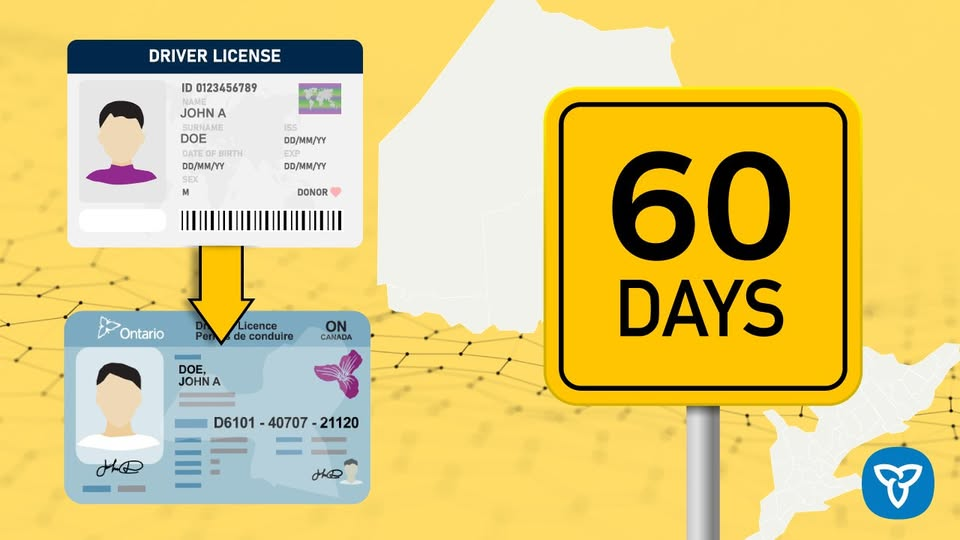
For newcomers arriving in Ontario, getting behind the wheel quickly is often a practical necessity. The good news is that if you already hold a valid foreign driver’s licence, you are not starting from zero. Ontario has a structured exchange process that can save you significant time and testing, but only if you understand the rules and arrive with the right documents.
How Long Can You Drive on a Foreign Licence?
When you move to Ontario and become a resident, you can use your valid foreign driver’s licence for up to 60 days. After that period, you are required to apply for an Ontario driver’s licence to continue driving legally (Ontario Ministry of Transportation [MTO], 2025). The licence must be valid, display a visible expiry date, and be written in English or French. If it is not, a certified translation is required.
This 60-day window is not a grace period to ignore. Planning your exchange appointment early, especially if you need documents translated or authenticated, is strongly recommended.
Does Your Country Have a Licence Exchange Agreement?
The most important factor in determining how much testing you will need is whether your home country has a licence exchange agreement with Ontario. A licence exchange agreement means that the jurisdiction’s licensing processes are secure, similar to Ontario’s, and in alignment with Ontario’s road safety goals (DriveTest, 2024).
As of 2025, Ontario has exchange agreements for cars, vans, and small trucks with all Canadian provinces and territories, all U.S. states, the Canadian Armed Forces, and the following countries: Australia, Austria, Belgium, Denmark, France, Germany, Great Britain, Hungary, the Isle of Man, Japan, New Zealand, Northern Ireland, Republic of Ireland, South Korea, Switzerland, and Taiwan (MTO, 2025).
If your country is on this list, you may be able to exchange your licence for an Ontario Class G licence without entering the full graduated licensing program. If you have fewer than two years of driving experience at the time of exchange, you may receive a Class G2 licence instead, and will need to hold it until you reach the two-year threshold before taking the G road test.
If Your Country Does Not Have an Agreement
Not being on the exchange list does not mean starting completely from scratch. Drivers from jurisdictions without an exchange agreement can still receive credit for their foreign driving experience. However, you will be required to pass all applicable tests to earn your Ontario licence (DriveTest, 2024).
Presenting a valid, original foreign driver’s licence at the time of application can earn you up to one year of driving experience credit automatically. If you want to claim more than one year, you will need to provide an Authentication Document, which is an official letter issued within the last six months by the licensing jurisdiction, consulate, embassy, or High Commissioner’s Office confirming your driving history. That letter must be written in English or French, or accompanied by a certified translation (DriveTest, 2024).
With sufficient proven experience, you may be able to skip the G1 waiting period and proceed directly to the G2 or G road test. As we covered in our G1 to G2 guide, the standard waiting period between stages is 12 months, so skipping it entirely through verified experience is a meaningful advantage.
What You Cannot Exchange
There are specific categories of licences that are not eligible for exchange regardless of your country of origin. You cannot exchange a learner’s permit from any jurisdiction, a licence that was cancelled due to alcohol-related offences or demerit points, a commercial licence class issued outside of Canada, or a school bus or driving instructor licence from any jurisdiction (MTO, 2025). Motorcycle licences from some exchange-agreement countries are also not exchangeable under the standard process.
If your licence falls into one of these categories, DriveTest staff can advise on what testing pathway applies to your situation.
Translation Requirements
If your foreign driver’s licence or supporting documents are not in English or French, a certified translation is mandatory. Ontario requires translations to be current, dated within six months of your application, and completed by an approved translator (MTO, 2025).
Approved translators include non-Canadian embassies, consulates, or a High Commissioner’s Office. Translators must provide proof of credentials, or be a member of a recognized professional association such as the Association of Translators and Interpreters of Ontario (ATIO). Unofficial translations from friends, family, or non-credentialed services will not be accepted.
Do not underestimate how long certified translations can take to arrange. Some authentication documents from consulates or licensing agencies abroad can take several weeks or months to obtain. If possible, begin this process before arriving in Ontario or immediately upon arrival.
Where to Apply and What to Bring
Licence exchanges are processed at DriveTest Centres, not ServiceOntario locations (with the exception of the ServiceOntario Bay and College location in downtown Toronto). Appointments are available and recommended as walk-in wait times at exchange locations can be extended (DriveTest, 2024).
When you visit, you will need to bring:
Your valid, original foreign driver’s licence. Your original identity documents showing your legal name and date of birth, as outlined in our document checklist for DriveTest visits. Any original supporting documents proving driving experience, in English or French or with certified translation. Payment for applicable fees. You will also need to pass a vision test on the day of your visit.
If you cannot provide full proof of experience at the time of your initial application, DriveTest allows you to return at a later date with additional documentation to have more experience credited to your record.
Common Mistakes That Slow Things Down
Most delays in the exchange process come down to a small number of avoidable errors. Arriving without a driver’s abstract or experience letter is the most common. Assuming your licence is automatically exchangeable without verifying your country’s agreement status is another. Bringing photocopies or uncertified translations instead of originals is a guaranteed way to have your application delayed.
The cost of getting licensed in Ontario, including government fees, lessons, and any required testing, is covered in our full breakdown of Ontario licensing costs. Understanding where the exchange process fits into that picture helps you budget and plan more accurately.
Getting Started with Drivisa
Whether your licence exchanges directly or you need to navigate the graduated system with experience credits, Drivisa connects you with MTO-approved instructors who understand the Ontario road environment and can help you transition confidently, regardless of where you learned to drive.
Ready to get on the road in Ontario? Find expert local instruction through Drivisa and make your transition as smooth as possible.
References
DriveTest. (2024). Licence exchanges and foreign licence applications. https://drivetest.ca/licences/exchanges-foreign-licences/
DriveTest. (2024). Foreign licence experience credits. https://drivetest.ca/licences/exchanges-foreign-licences/foreign-licence-experience-credits/
DriveTest. (2024). Licence exchanges: cars, trucks, vans. https://drivetest.ca/licences/exchanges-foreign-licences/licence-exchanges-cars-trucks-vans/
Ontario Ministry of Transportation. (2025). Exchange an out-of-province driver’s licence. Government of Ontario. https://www.ontario.ca/page/exchange-out-province-drivers-licence
Ontario Ministry of Transportation. (2025). Getting your driver’s licence. Official MTO Driver’s Handbook. https://www.ontario.ca/document/official-mto-drivers-handbook/getting-your-drivers-licence
